
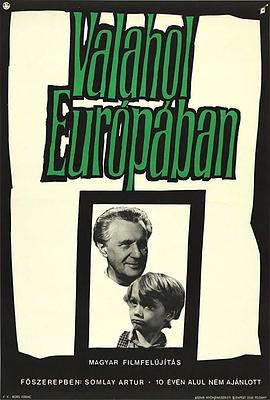
Somewhere in the remote region, the war ends. In the midst of ruined cities and houses in the streets, in rural hamlets, everywhere where people still live, are children who have lost their homes and parents. Abandoned, hungry, and in rags, defenseless and humiliated, they wander through the world. Hunger drives them. Little streams of orphans merge into a river which rushes forward and submerges everything in its path. The children do not know any feeling; they know only the world of their enemies. They fight, steal, struggle for a mouthful of food, and violence is merely a means to get it. A gang led by Cahoun finds a refuge in an abandoned castle and encounters an old composer who has voluntarily retired into solitude from a world of hatred, treason, and crime. How can they find a common ground, how can they become mutual friends The castle becomes their hiding place but possibly it will also be their first home which they may organize and must defend. But even for this, the price will be very high. To this simple story, the journalist, writer, poet, scriptwriter, movie director, and film theoretician Béla Balázs applied many years of experience. He and the director Géza Radványi created a work which opened a new postwar chapter in Hungarian film. Surprisingly, this film has not lost any of its impact over the years, especially on a profound philosophical level. That is to say, it is not merely a movie about war; it is not important in what location and in what period of time it takes place. It is a story outside of time about the joyless fate of children who pay dearly for the cruel war games of adults. At the time it was premiered, the movie was enthusiastically received by the critics. The main roles were taken by streetwise boys of a children's group who created their roles improvisationally in close contact with a few professional actors, and in the children's acting their own fresh experience of war's turmoil appears to be reflected. At the same time, their performance fits admirably into the mosaic of a very complex movie language. Balázs's influence revealed itself, above all, in the introductory sequences an air raid on an amusement park, seen in a montage of dramatic situations evoking the last spasms of war, where, undoubtedly, we discern the influence of classical Soviet cinematography. Shooting, the boy's escape, the locomotive's wheels, the shadows of soldiers with submachine guns, the sound of a whistle—the images are linked together in abrupt sequences in which varying shots and expressive sharp sounds are emphasized. A perfectly planned screenplay avoided all elements of sentimentality, time-worn stereotypes of wronged children, romanticism and cheap simplification. The authors succeeded in bridging the perilous dramatic abyss of the metamorphosis of a children's community. Their telling of the story (the scene of pillaging, the assault on the castle, etc) independently introduced some neorealist elements which, at that time, were being propagated in Italy by De Sica, Rossellini, and other film artists. The rebukes of contemporary critics, who called attention to formalism for its own sake have been forgotten. The masterly art of cameraman Barnabás Hegyi gives vitality to the poetic images. His angle shots of the children, his composition of scenes in the castle interior, are a living document of the times, and underline the atmosphere and the characters of the protagonists. The success of the picture was also enhanced by the musical art of composer Dénes Buday who, in tense situations, inserted the theme of the Marseilaise into the movie's structure, as a motive of community unification, as an expression of friendship and the possibility of understanding. Valahol Europaban is the first significant postwar Hungarian film. It originated in a relaxed atmosphere, replete with joy and euphoria, and it includes these elements in order to demonstrate the strength of humanism, tolerance, and friendship. It represents a general condemnation of war anywhere in the world, in any form.
关联推荐
猜你喜欢
 HD杨竣羽 彭静 刘倬廷 故事发生于唐高祖武德年间,由著名历史事件玄武门之变改编而成。故事的主线以江湖侠客李御风欲助李世民洗脱枉罪,遂以性命担保,以七日为限,追缴刺杀李渊嫁祸李世民的真正凶手,却意外发现了玄铁魔欲助李建成杀死李
 HD山下智久 木村文乃 浅利陽介 渡邉このみ 波岡一喜 塚地武雅 木本武宏 中村靖日 星野真里 船越英一郎 成海朔(山下智久 饰)是一名在大学担任心理学副教授的青年,这一天曾相恋多年的前女友(木村文乃 饰)走入课堂,拜托他协助担任刑警的弟弟安孙子贤人(浅利阳介 饰)调查新近发生的一起案件。不久前,一个名叫八
 正片Jona Eisenblätter Uschi Glas Günther Maria Halmer 9 岁的麦克斯和他的母亲一起搬到了 Geroldseck 城堡,他的母亲在养老院担任护士。 显然,一个狡猾的小偷在这里作恶。 麦克斯的母亲被怀疑威胁要解雇她。 这就是为什么马克斯和七号桌的三名疗养院居
 正片二宫和也 柴崎幸 大仓忠义 堀北真希 玉木宏 佐佐木藏之介 18世纪初,日本正处于德川幕府统治时期。是时一种名为“赤面疱疮”的恶疾在岛内流行,患病者无一例外皆为男性,此恶疾顽固难治,致令死亡人数不断攀升,更令日本国内男女比例严重失调。居住在江户的旗本武士水野家
 正片西恩·哈里斯 伊文·莱斯利 马修·桑德兰 斯蒂夫·莫察基斯 乔尔·埃哲顿 弗莱彻·汉弗莱斯 Melanie·Lyons·Melanie·Lyons Garry·Waddell·Garry·Waddell Brett·Hicks-Maitland·Brett·Hicks-Maitland Peta·Shannon·Peta·Shannon Adam·Morgan·Adam·Morgan 乔尔·埃哲顿、西恩·哈里斯将主演犯罪题材新片[未知的男人](The Unknown Man,暂译)。托马斯·M·赖特([严重的不幸])自编自导。该片根据真实事件改编,讲述两个男人在飞机上相遇,并开启了
 正片Priscila Bittencourt Isabela Torres 马尔 13岁的伊莲娜来自一个传统的家庭。有一天她发现父亲居然有另一个家庭,还有一个和自己同龄的女儿,她的名字也叫伊莲娜。两个女孩成了好朋友,伊莲娜反复探讨父亲在秘密跟谎言的游戏中过着的双面人生。
 10.0正片奥平大兼 出口夏希 佐野晶哉 菊池日菜子 早濑憩 本片改编自住野夜同名小说。阿京、山姆、空空、阿冢和艾蒙五人是同班同学。总是缺乏自信的阿京,很在意明亮开朗的女同学,绰号「山姆」的三木,然而山姆似乎对总是保持王子形象的阿冢怀着好感──因为拥有奇妙能力的
 7.0更新HD中字栗山千明 武田航平 K?hei Takeda 辻凪子 馬場裕之 おかやまはじめ 在房地产公司做销售工作的伊泽美幸(栗山千明饰),深受公司的信赖,每天都过着一帆风顺的生活。另一方面,她也有不为周围人所知的一面。那就是,考虑“在一天结束的时候如何才能喝好喝的酒”,把工作以外的时间全部
 7.0HD古月 孫敏 影片以四十年代至七十年代毛泽东壮年至晚年的大量生活细节和情感生活片段为线索,描述了他从陕北东渡黄河解放全中国到重返韶山故里情;从痛失儿子毛岸英至大阅兵等各个情节里的言谈举止,吃饭穿衣,生活中的幽默和睿
 6.0HD冯淬帆 叶德娴 秦沛 陈国新 周润发 梁朝伟 岑建勋 马斯晨 女记者(叶德娴 饰)受托跟踪采访一个忠实于精神病患者救助事业的社会工作者(冯淬帆 饰),二十多年来他一直与街头流浪汉打交道,旨在引导他们走向康复,但他的行为得不到人们的响应。女记者亲眼目睹了他对垃圾佬
 正片李全斌 孙娇娇 陈开鼎 大森 张丹彤 一个糟少年无意中得到了灵力,一改以往形象成为翩翩少年郎,当他有勇气向心仪 的女孩表白的时候,却发现女孩是魁主的手下,他们要抓到身有异力少年在抓99个人来让魁主真正的复活,一场人与魁主之间的较量就此
 6.0正片Sam Favret Jonathan Charlet 霞慕尼,坐落于欧洲屋脊阿尔卑斯山最高峰——勃朗峰脚下,这里是登山者的故乡,滑雪者的天堂。这里有着漫长的冬季,每年来登山和滑雪的旅客不计其数。霞慕尼也是山姆引以为傲的故乡,他在高高绵延的山脉里出生成长,